Introduction
The workflow and applications of scSpecies are demonstrated in two tutorial notebooks, covering dataset preprocessing, architecture alignment, annotation transfer, differential gene expression analysis, and atlas creation across species.
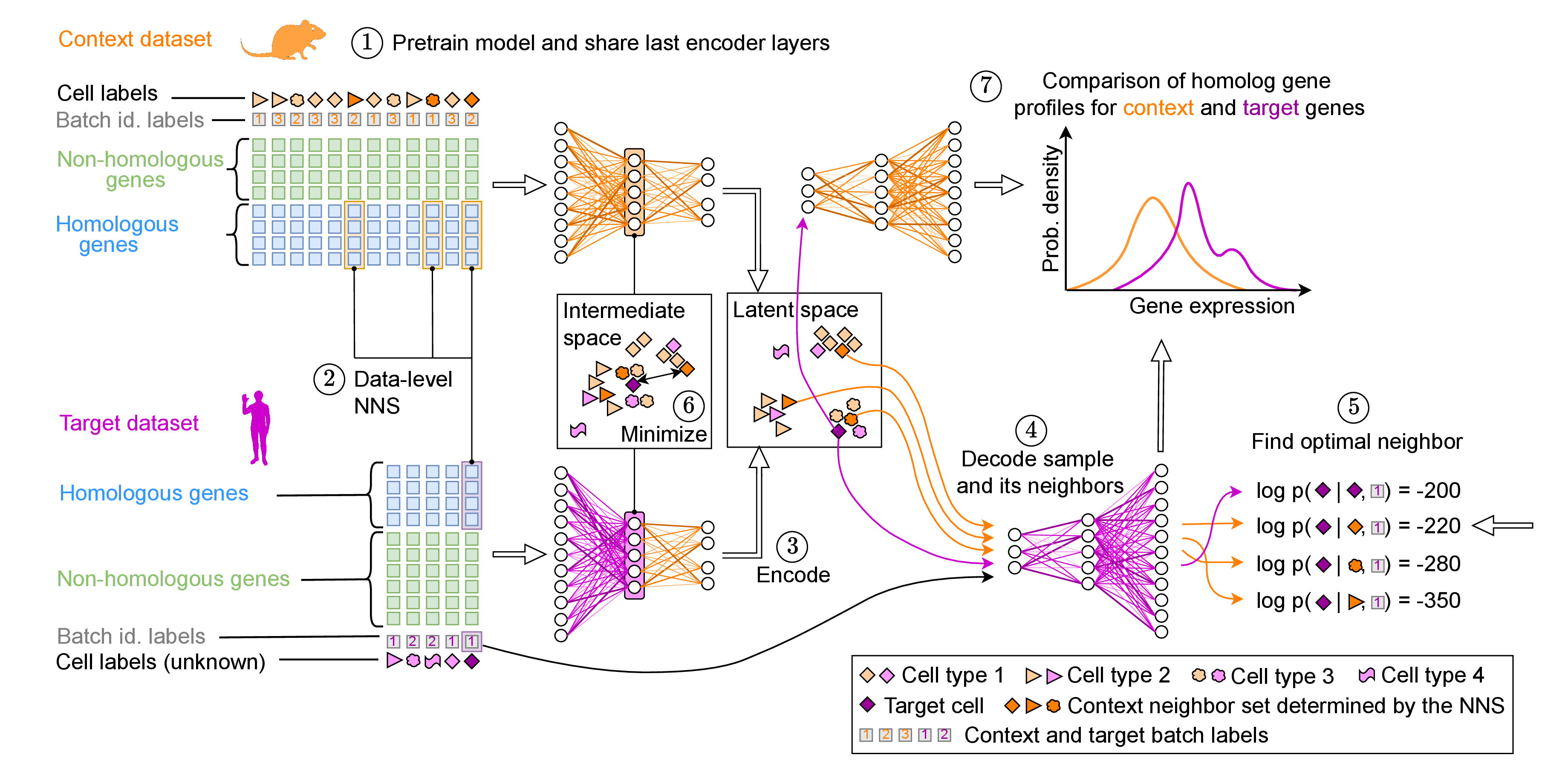
scSpecies model architecture and workflow.
Key functionalities of scSpecies
Align and visualize latent representations:
scSpecies aligns latent representations of datasets across species. The influence of experimental batch effects on the latent representation is removed internally.
Compute cell similarity scores:
scSpecies defines a similarity metric that establishes a direct correspondence between cells of different datasets and can quantify similarity of cells across species.
Transfer cell annotation between species:
Cell type labels or other annotation can be transferred via a neighbor search on the aligned latent space.
Match cell type annotation:
scSpecies helps to identify homologous cell types and can match label annotation.
Differential gene expression analysis:
scSpecies aids in identifying differentially expressed genes among biologically similar cells across datasets.
Aligned cell atlas creation:
scSpecies can create an aligned cell atlas that spans multiple species.
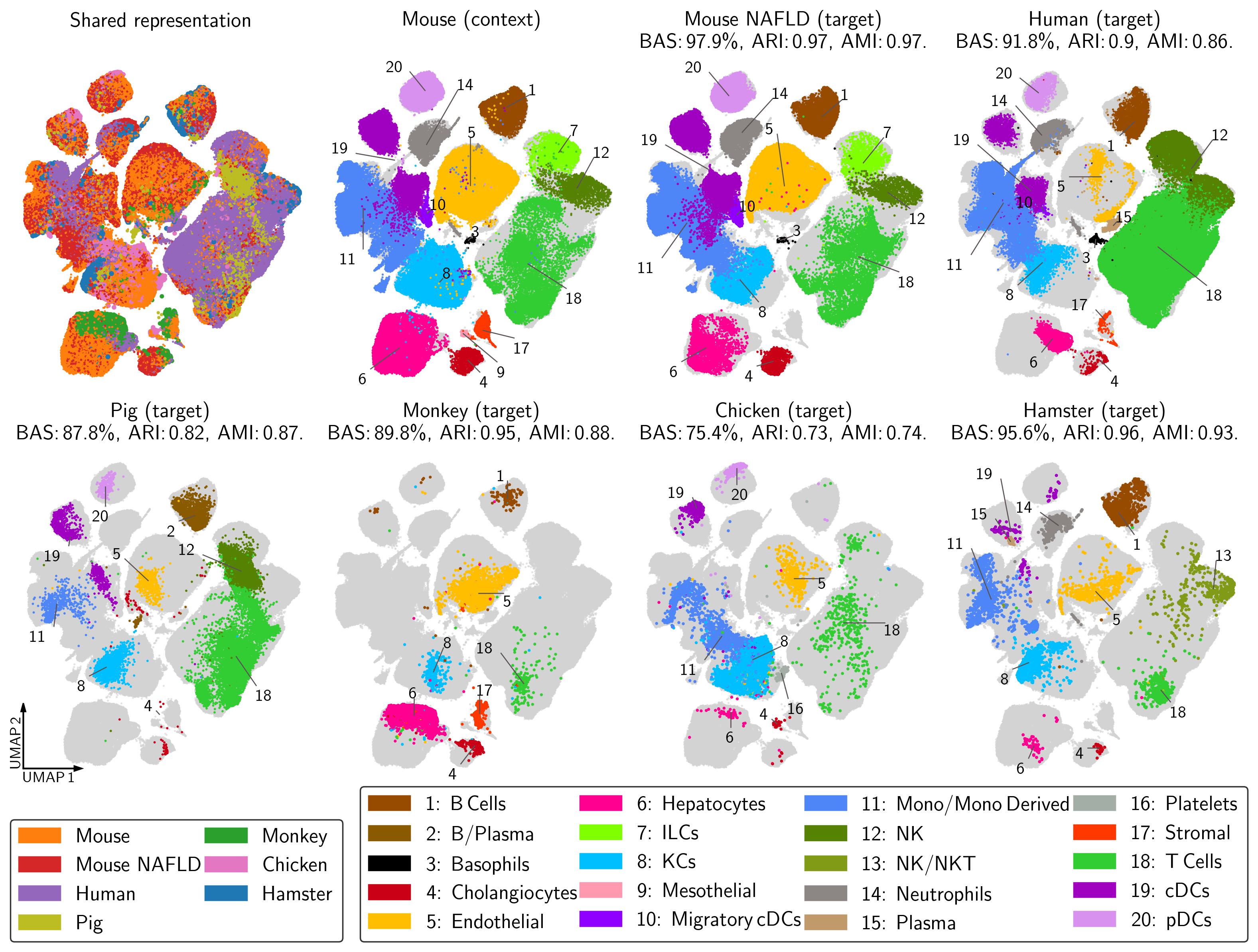
Aligned latent representations of liver cell samples across multiple species.
Requirements for training scSpecies
To train scSpecies, two scRNA-seq datasets are required:
A context dataset for pre-training.
A target dataset for fine-tuning.
Datasets must meet the following criteria:
Both must contain raw count data as a Compressed Sparse Row sparse matrix of dtype ‘float32’ in the .h5ad format.
Both must store gene identifiers as gene symbols (e.g., Sox17, ISG15) in .var_names, following species-specific naming conventions.
Both must include experimental batch labels for both datasets in the obs layer.
The context dataset must include cell type annotations in the obs layer.
Preprint
The methodology of scSpecies is available at:
Clemens Schächter, Martin Treppner, Maren Hackenberg, Hanne Raum, Joschka Boedecker, Harald Binder (2024). scSpecies: enhancement of Network Architecture Alignment in Comparative Single-Cell Studies. Genome Biology. doi:10.1186/s13059-025-03866-2
Funding
Funded by the Deutsche Forschungsgemeinschaft (DFG, German Research Foundation) - Project-ID 499552394 - SFB 1597 Small Data. For more information, refer to the Small Data homepage.